

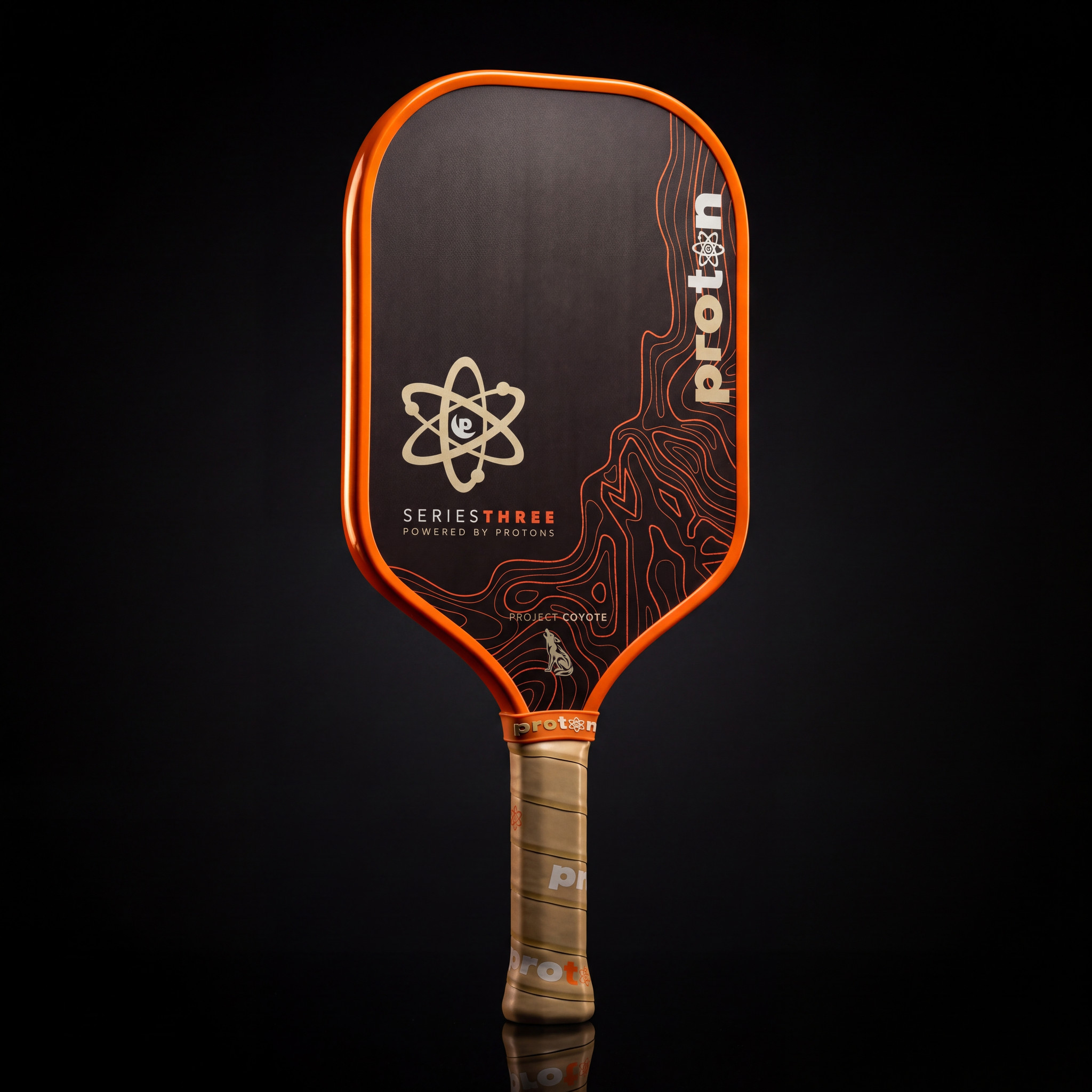
Project Coyote is Proton's newest paddle: an elongated build on an all-new construction with a redesigned throat taper. The most powerful and lightest paddle yet.
That is Proton's claim. The more interesting question is what people outside the building said once they got one in hand.
What independent reviewers said
The Kitchen Pickleball, one of the sport's most-followed gear desks, ran a full review. Their verdict was blunt:
Proton just released what we think is the company's best paddle to date.
What stood out to them was not raw pop on its own. It was how manageable that pop turned out to be — the balance that is genuinely hard to engineer, because most paddles buy one at the cost of the other.
The response off the face is powerful but also very predictable.
A well-executed, balanced paddle that avoids gimmicks in favor of reliable performance.
Instagram gear accounts landed in similar territory. @jj.pickleball posted a first look calling it "Proton's newest Gen 3 paddle." @mattspickleball tried the 15mm and summarized it in three words: "REALLY GOOD."
What's inside the build
The Coyote pairs a polypropylene honeycomb core with a reinforced-foam perimeter. That hybrid is doing the work behind the review notes above — foam around the edge adds power, widens the usable face, and keeps the paddle composed when contact drifts off center. Predictability on mishits is usually where light, elongated paddles fall apart. This construction is aimed squarely at that problem.
The other change is the throat taper, which was redesigned to smooth the handle-to-face transition. In practice that means the paddle accelerates quickly and stays responsive as the pace climbs — hands battles at the kitchen line, resets you have to take late.
The published spec sheet:
- Average weight: 7.7 oz
- Swing weight: 116.8
- Thickness: 15 mm
- Length: 16.5 in
- Handle: 5.5 in
- Grip: 4.125 in
It is dual-stamped for UPA-A and USA Pickleball, so it is tournament-legal out of the box. No approval paperwork to chase before your next event.
Who the Coyote is for
The 16.5-inch length and 5.5-inch handle put this squarely in elongated territory. You get reach and leverage at the top of the face, and enough handle for two-handed backhands. The tradeoff with elongated shapes is usually a narrower sweet spot; the foam perimeter is the counterweight to that.
The 7.7 oz average weight is the part players tend to feel first. A lighter head is faster to reposition, which matters most in the exchanges where you are reacting rather than setting up. If you have been playing a heavier paddle and losing hands battles, that is the variable worth testing.
If you want something different, the rest of the Proton paddle lineup covers other shapes and feels — Peacock (Series Three), Roadrunner and Flamingo each solve a different problem. The Coyote is the newest of the group, not automatically the right one for every game.
Where it sits in the lineup
Proton is a PPA Tour Platinum partner, and Proton paddles are in play on the MLP and PPA tours. That is the environment these builds get tested in before they reach a retail page.
The Coyote arrived as the value entry in the paddle line, which is part of why the reviews got attention — reviewers generally expect compromises at that position in a lineup, and the write-ups did not find the usual ones.
Full details, the complete spec breakdown and current pricing are on the Project Coyote collection page. Proton also builds slow-pitch softball bats if that is the other half of your season.
Reviews are a starting point, not a verdict. The useful test is whether a paddle fits how you actually play. But when independent testers converge on the same two words — powerful and predictable — that is worth a look.


